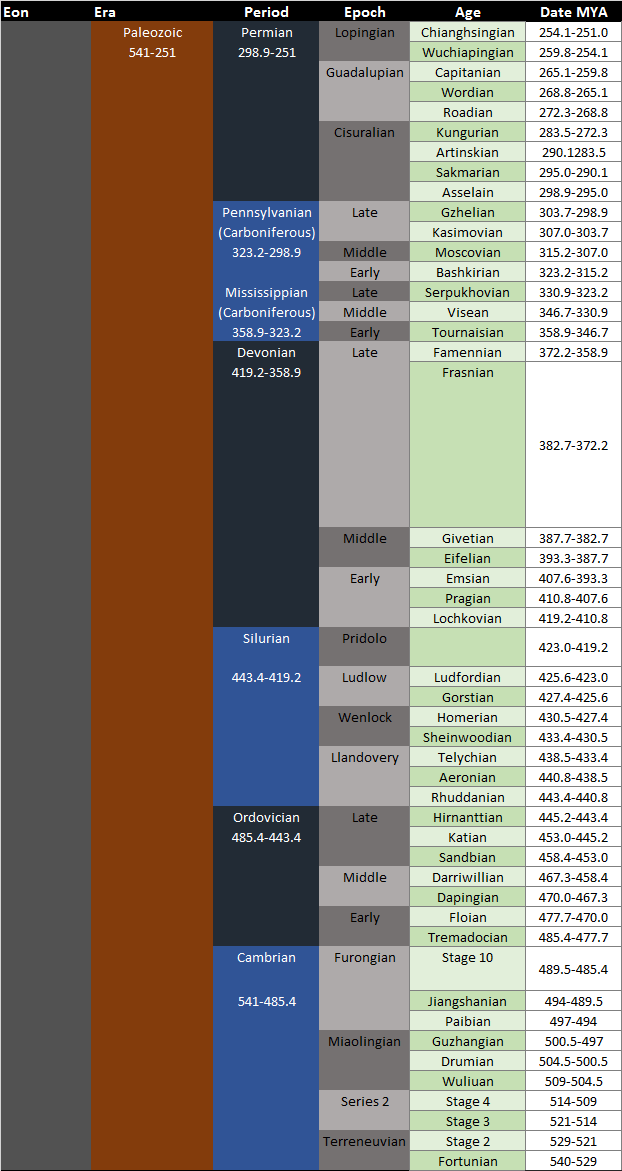
In my previous post I looked at the Earth’s history through the Hadean, the Archean, and the Proterozoic Eons, covering a length of time from 4.6 billion to 541 million years ago. We now move into the Phanerozoic Eon, which ranges from 541 million years ago to the present day. In particular, I will be looking at how the planet developed in the Paleozoic Era. These are all geological time periods that allow scientists to identify and better understand prehistory. Eons are divided into Eras, with the exception of the Hadean, and Eras are divided into Periods. Further divisions of Epochs and Ages are also used.
The Paleozoic Era is a time of great extremes. It begins with the Cambrian Explosion when life made a massive evolutionary leap forward, radiating into many ecological niches and producing more complex and sophisticated lifeforms. Oxygen volume rose to 12.5% and CO2 measured 4500ppm (parts per million). Sea levels generally rose. Solar luminosity increased to 94%.
Despite the explosion of life, the Era also saw several significant extinction events. Ocean anoxia, a sudden depletion of Oxygen in the seas, appears to have caused 50-80% of marine animals to die in a period from 514 to 504 million years ago. Despite this the first jawless fishes appeared but another extinction event killed off nearly 40% of marine animals.
The Andean-Saharan Ice Age began 453 million years ago and would last some 43 million years. Its beginning is marked by the Ordovician-Silurian Extinction Event that caused 60 to 70% of all species to disappear. At its end plants had colonised the land and the first insects appeared. Fishes with true jaws were also to be found in the seas. The Earth day was now 21 hours long.
At the end of the Devonian Period another Extinction Event occurred. The oceans appear to have lost Oxygen again. 70% of all species were to die in a period of some 20 million years. Scientists believe that there were extinction pulses during this time, in-between which the first amphibians evolved, as well as trees. It was also the beginning of the Karoo Ice Age, which would last for 133 million years.
346 million years ago the great supercontinent Pangea began to form and by 283 million years ago it was the single continent on the face of the planet. Earth’s day now lasted 22 hours long and the Moon was 375,000 km away. Animals laying eggs appeared, allowing for the development of reptiles. The amount of Oxygen in the atmosphere reaches 30%. Conifer trees and cycads dominate the landscape. The Karoo Ice Age ends around 265 million years ago. It is followed by a period of volcanic activity, leading in a rise of temperature, perhaps as high as 50 or 60C. Methane (CH4) and Hydrogen sulphide (H2S) increase in atmospheric volume, and CO2 drops to 2000ppm. Another mass Extinction Event is triggered. It marks the boundary between the Permian and the Triassic Periods, as well as the end of the Paleozoic Era. It is estimated that 96% of marine species, 70% of terrestrial vertebrates, and 83% of insects die.
The Paleozoic Era began with an explosion of life but ended with one of the greatest mass Extinction Events that we know of. Fortunately, life found a way to survive and in the next Era, the Mesozoic, some of the most impressive animals ever to live were about to appear; the dinosaurs.
 Peter C Whitaker