The Permian Period ended with an increase in the Earth’s temperature following the end of the Karoo Ice Age and the forming of the single supercontinent of Pangea. The Triassic Period, the first of the three geological periods that make up the Mesozoic Era, begins with a period of recovery. There is no polar ice, just as there has not been for much of the planet’s history so far. The ancestors of the dinosaurs that appeared in the late Permian begin to radiate into niches left vacant by the mass Extinction Event that marks the Permian-Triassic boundary. They will go onto become the dominant lifeform for the rest of the Mesozoic Era. In the seas, large marine reptiles like Icthyosaurs and plesiosaurs thrive. Pterosaurs rule the skies. The mean surface temperature of the Earth is some 17C. Oxygen content has dropped to 16%. CO2 levels have also dropped to 1750ppm, which is still 6 x pre-industrial levels of the human world in the future.
Volcanic eruptions continue, pumping large amounts of gasses into the atmosphere. Another Extinction Event occurs at the geological boundary of the Triassic and the Jurassic Periods. Some 75% of all species die. Moving into the Jurassic Period Pangea, the supercontinent, begins to break apart. The surface temperature of the planet remains relatively constant at 16C. In the atmosphere Oxygen increases again to 26%, about 130% of todays level, and CO2 also increases to 1950ppm, which is 7 times greater than pre-industrial levels.
There is no extinction event to mark the move into the Cretaceous Period from the Jurassic. Geologically, it is a time of large continental movements, however. Africa and India separate from Antarctica, which is still quite north of its position today. South America splits from Africa, helping to form the Atlantic Ocean. The Western Interior Seaway divides North America into Laramidia (west) and Appalachia (east). Flowering plants have appeared. There is a proliferation of single-cell organisms that change the ocean’s composition. Australia breaks away from Antarctica, which continues moving southwards. Volcanic eruptions continue.
Around 65 million years ago a huge asteroid impacted in what is now the Yucutan region of Mexico. It triggers the Cretaceous-Paleogen Extinction Event. 70% of all species, including all the dinosaurs, die. Oxygen has risen to 30% but CO2 drops to 1700ppm. The mean surface temperature has risen to 18C.
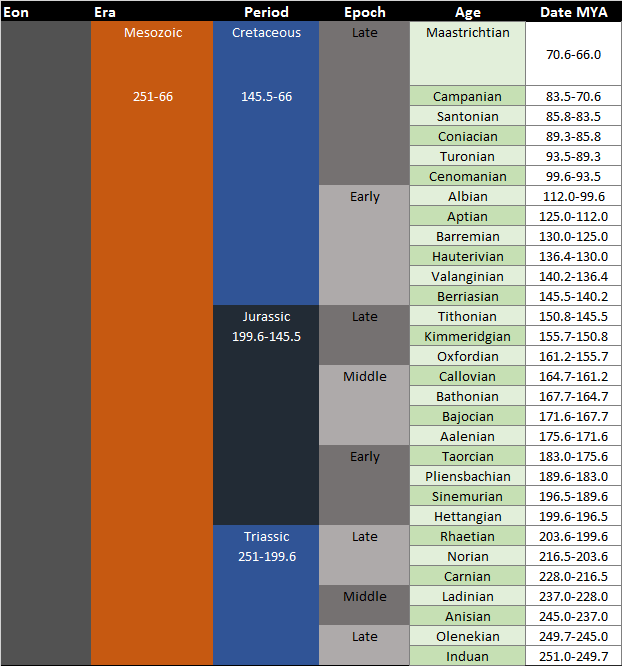
During the time of the dinosaurs the Earth is generally a much warmer place than it is today. The Era is marked by plate tectonic movement as the world begins to resemble the arrangement of continents that we recognise now. There is also a lot of volcanic activity, which fills the atmosphere with large amounts of gasses. Mammals, for the most part small and few in number, survive the end of the Cretaceous Period, as do the birds, direct descendants from the dinosaurs. The Mesozoic Era lasted from 251 to 66 million years ago. It gives way to the Cenozoic Era, which is the geological period that we live in today.
 Peter C Whitaker