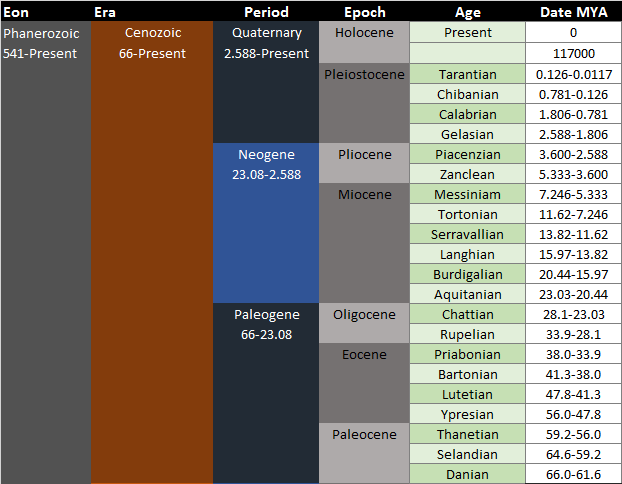
After the reign of the dinosaurs throughout the Mesozoic Era the age of mammals arrives with the Paleogen Period of the Cenozoic Era. The first grasses appear, along with placental mammals. Orogrny, mountain building, starts in Laramidia, the western half of North America, resulting in the formation of the Rocky Mountains. Volcanic eruptions lessen. India collides with Asia and the result is the beginnings of the Himalayas. The Earth day is now 24 hours long and the first primitive primates, the ancestors of humans, appear.
The mean surface temperature of the Earth is still around a warm 18C. The amount of Oxygen in the atmosphere has dropped to 26% and CO2 is now at a low of only 500ppm, about 2 x times pre-industrial levels. As the first elephant species with tusks appear the Late Cenozoic Ice Age begins, 33 million years ago. It will be a prolonged period of global cooling interspersed with glacial and interglacial periods. A glacial period is when the Earth cools and ice sheets or glaciers extend from the poles towards the equator. Interglacial periods are when the ice recedes, and the temperature generally rises. Not long after the beginning of this latest ice age the La Grarita supervolcano, in what is now Colorado, North America erupted.
As the world cools to 14C, the same as today, the African-Arabian plate joins with Asia. Circum-polar ocean circulation builds up the Antarctic ice cap. Continental interiors experience a period of drying. Oxygen in the atmosphere drops to 21% and CO2 also falls to 280ppm. During this period the first upright walking primates appear. North and South America are joined together by the Isthmus of Panama, changing the flow of ocean currents. Around 3.6 million years ago the Arctic ice cap forms.
Our ancestral primates evolve, from Australopithecus through Homo habilis, to Homo erectus. The Quaternary Glacial begins and is still ongoing today. Yellowstone supervolcano erupts. Homo neanderthalensis, the Neanderthals, appear and move north out of Africa. There is a long succession of glacial periods and eruptions from supervolcanoes. Some 126,000 years ago, Homo sapiens migrate out of Africa and into Europe and Asia. Neanderthals interbreed with non-African humans. Australia is ravaged by bush fires, which destroy many habitats and leads to the extinction of its megafauna.
40,000 years ago, Neanderthals become extinct. 19,000 years ago, the Bering land bridge forms allowing humans to migrate to North America. Antarctic sea ice begins to melt. The last glacial period appears to end 11,400 years ago. Again, both Oxygen and CO2 levels have dropped slightly, but the planet’s mean surface temperature stays around 14C. Megafauna such as mammoths and sabretooth cats have gone extinct. By 10,000 years ago humans have reached the most southerly point in South America. It is only a relatively short time later when agriculture is developed in the Fertile Crescent with cows and sheep being domesticated. 6,500 years ago, the sea levels rise, and Britain becomes an island, cut off from Europe.
Civilisation begins some 5500 years ago in Mesopotamia. The plough is invented, and humans start using copper and bronze. Around 4000 years ago the Egyptians start using a calendar and the wheel is invented. The first forms of writing quickly appear. 3100 years ago, the 1st Dynasty rule Egypt and the world begins to look much like it does today.
The journey from prehistory over a span of some 4.6 billion years is complete.
 Peter C Whitaker