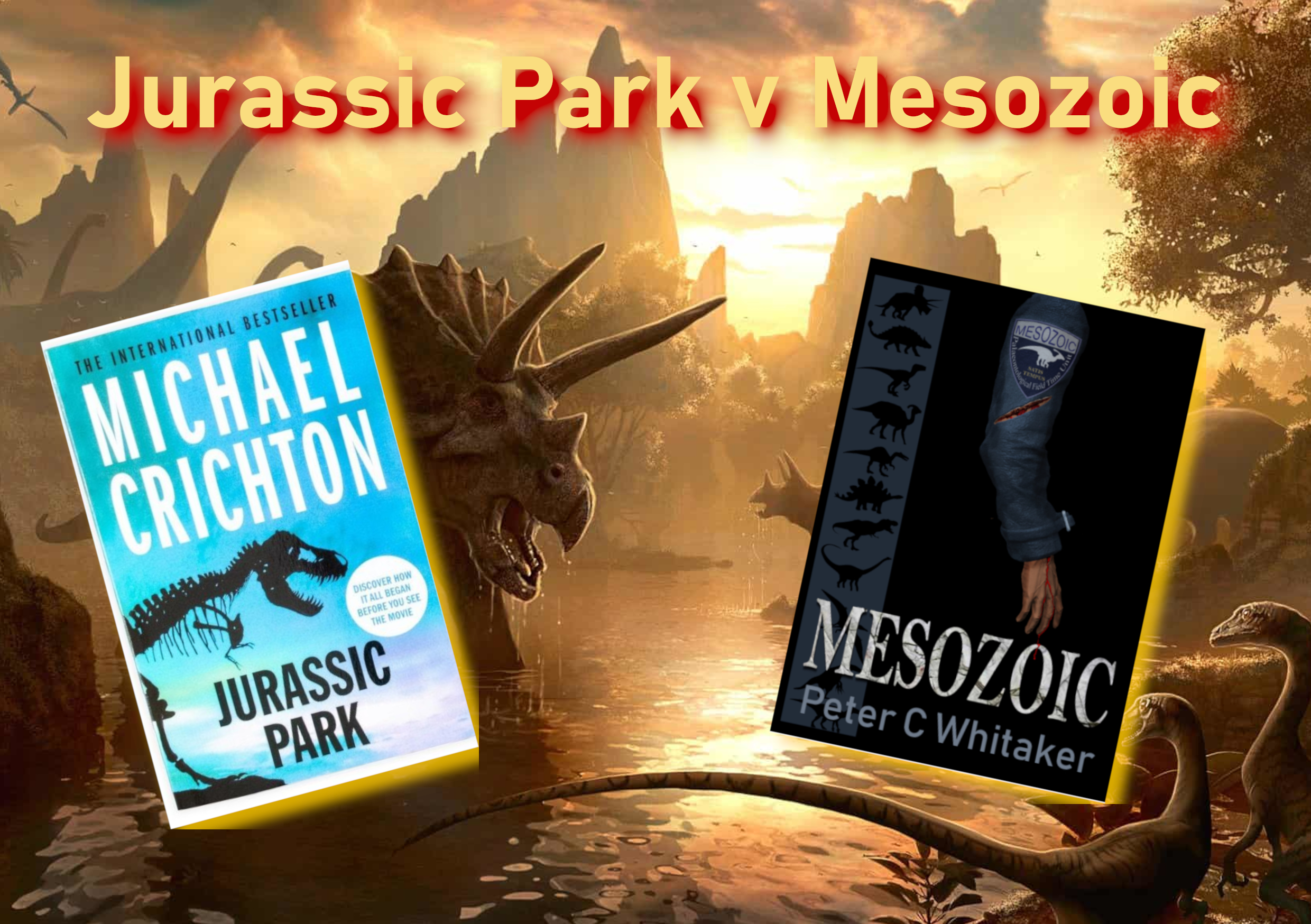
Time has not been kind to Jurassic Park, the novel. I remember reading it the first time and I struggled then with at least the first third of the book. I also struggled with the rather strange interpretations of science that Michael Crichton wrote into the story, but I will leave that until later. Most of the initial problems are technical, as in a writing form; the book takes too long to get going. It introduces a lot of spurious characters who act out scenes that add very little to the story. Even worse, they slow the pace of the book down to the point where it is desperately pedestrian. This is surprising in a novel that was billed as a technological thriller, it is even worse for a book that actually is just an adventure story. The one great thing about Jurassic Park is the idea; resurrecting dinosaurs from recovered DNA.
As an author, Michael Crichton adhered to a simple premise; science discovers a new power, fails to control it, and it gets out. Crichton’s previous bestseller, The Andromeda Strain, which also became a hit movie in 1971, works on this principle. It is clearly evident in Jurassic Park. The scientists have unleashed the power of genetic engineering to create a theme park that houses living dinosaurs as its main attractions. The apparent control that the humans have over their creation is revealed as illusionary when the electrical power goes down and the animals break free. That is when the action starts.
In truth, there probably would not have been much action at all. Animals break free both in and from zoos, up to five times a year apparently, but they do not appear to go on murderous rampages. They are often killed simply out of fear as a consequence of achieving their liberty. In human-animal encounters it is usually the animal that is the more likely to die. That might have made an interesting version of Jurassic Park, but it was not the idea that Crichton decided to pursue. Instead, he chooses to consciously represent the dinosaurs inaccurately, more as monsters than animals. The psychology of the dinosaurs, in particular the predators, is illogical. Whether it is the Tyrannosaurus Rex or the Velociraptors, they have one thing in common, an unnatural obsession with eating humans.
In the book, Alan Grant and the two kids, Alex and Tim, are relentlessly pursued by the T-Rex. This is an apex predator that evolved to prey on large herbivores. It was as clever as it needed to be to do such a thing. I believe that this huge animal would have been largely unimpressed with humans as a food source. When surrounded by animals that it was both designed and programmed by instinct to hunt and eat why would it waste any effort on trying to catch small squishy things that ran around making a lot of noise? When T-Rex lived in the late Cretaceous there were dinosaurs of a comparable size to humans, but palaeontologists are generally of the opinion that an adult T-Rex would save its energy for its normal prey choices. It might, if the opportunity presented itself, take a smaller dinosaur as an appetiser, but it was hardly likely to spend much time in the pursuit. Today’s large predators, lions and tigers for example, simply choose not to bother with the small fry when there is plenty of their normal prey available.
There is one scene in the book that, thankfully, did not make it into the movie. It involved the T-Rex doggedly pursuing its humans down the jungle river to a waterfall. The kids are left momentarily alone in a recess leads to a maintenance room behind the waterfall. The T-Rex cannot reach them when it shoves its head through the falling water, so it extends a long prehensile tongue to latch onto Tim’s head and pull him forward! I am not sure where Crichton got this idea from, but it certainly was not as a result of an examination of wildlife, prehistoric or existing. The concept is illogical. Why would a predator with a mouthful of large serrated knives for teeth need a long prehensile tongue that reaches out over said sharp and dangerous weapons? When the T-Rex finally succumbs to the sedative shot into it by Muldoon, it suffers a very obvious fate; it bites its ridiculous tongue!
I have already mentioned the Velociraptors, well, they are not Velociraptors; they are an animal called Deinonychus, which happens to be one of my favourite dinosaurs. This mistake was the result of another conscious decision on Crichton’s part. Deinonychus were large, active, predators that, in life, achieved the same size as the animals portrayed as ‘raptors’ in the movies. Velociraptors were much smaller and, therefore, far less dangerous to humans. I think the clue as to why he did this is in the name. Modern birds of prey are known as ‘raptors. Americans like to contract words, so, it is an easy step to reduce Velociraptor to raptor. Sounds cool too. Contracting Deinonychus does not really produce an equally cool alternative. There is a very cringe-worthy scene in the movie in which Alan Grant points out the similarities between birds and dinosaurs, particularly the Velociraptor fossil that they are digging up, by referring to their name being birdlike. There is no logic or science in what he says, however.
There is also no logic or science to underpin Crichton’s suggestion that his raptors are at least as smart as chimpanzees either. Although Deinonychus and its relatives, which include the smaller Velociraptor, had large eyes, were agile, and had hands that could grasp and hold onto something, like a struggling animal for example, there is no suggestion in the skulls that have been examined by palaeontologists that their brains were exceptional enough to conclude that they were as intelligent as the author suggested. Their behaviour would have been very similar to T-Rex in that they had evolved to prey on certain animals and no doubt they were smart enough to do exactly that. Just like the giant therapod, these raptors probably would not have viewed humans as a viable food source, despite being much closer in size. They may have expressed a degree of curiosity, predators tend to have that attribute more than most herbivores, but it is not likely to inspire them to become psychopathic killing machines.
I have to admit that when I wrote Mesozoic I had an agenda of my own, which was to put right many of the mistakes regarding the animals in the whole Jurassic Park franchise. I set out to portray my dinosaurs as accurately as the evidence then available allowed. There is a long list of prehistoric animals putting in an appearance in Mesozoic. The members of the Palaeontological Field Time Unit (PFTU) are all aware that the prehistoric animals can be just as dangerous as any animal in the modern world. They act accordingly. However, the PFTU are not laden down with military grade weapons when they go back in time to walk amongst dinosaurs. They carry stock-prods that are used only when absolutely necessary. Some of my characters are killed by the dinosaurs, however. Mostly, this is the result of them provoking the animals, although one character dies almost by accident when they unwittingly trigger an Allosaurus’ snap reflex response.
Earlier, I mentioned that in most animal-human encounters it is the animal that comes off worst, and that is generally, true, but just occasionally, as in Mesozoic, it can go the other way. The fact is that humans are proven to be the most dangerous of animals. The opening chapter to Mesozoic sees a Triassic predator, a Postosuchus, attacking a prey animal. It is a natural event, violent and bloody, yes, but just an example of how predation works. Following that event a man plans and then enacts a murder that initiates the plot that then develops. The pace increases as the PFTU realise that they are in danger of being stranded in the Triassic Period. In terms of animal behaviour there is no logic to what the man does. He is being entirely human, acting on impulses that are not limited to those governed by instinct and necessity as in animals. A T-Rex could only ever be a T-Rex. It, like most other animals, lacks the capacity to act in any other way. For the dinosaurs of Mesozoic the humans that walk amongst them in their encounter suits are hardly notable. The PFTU know that if they avoid any direct contact with the dinosaurs then they have a reasonable expectation of avoiding any dangerous situations. The only thing that puts them in such dangerous situations is a psychotic killer, who happens to be a human, not a dinosaur.
 Peter C Whitaker