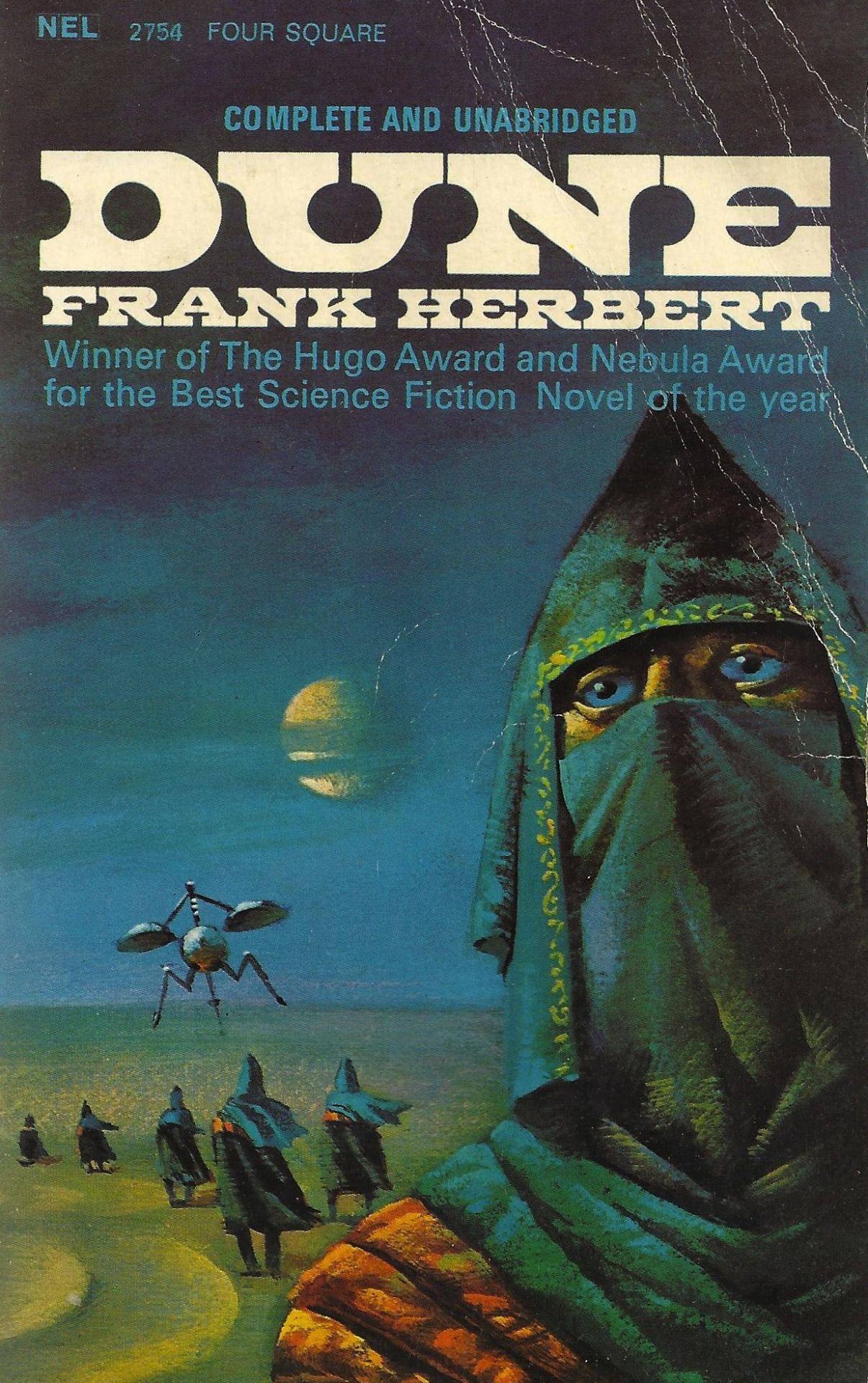
I stumbled onto Frank Herbert’s novel when I was a teenager. I remember that it was a paperback book with a rather garish image of what looked to be a Bedouin man with vibrant blue eyes, which seemed to be rather strange for a work of science fiction. Despite the incongruous depiction I bought and read the book. I read it many times.
Dune is not really a science fiction book, it is closer to epic fantasy, it just has a patina of science fiction elements, but this adds to its appeal. The basic story is easy to understand, it concerns a man fulfilling a prophecy, subverting it also to achieve his own goals, when he maintains his aristocratic family’s fight against its enemies, the House Harkonnen and the Emperor Shaddam Corrino IV. This war is played out mainly against the landscape of the planet Arrakis, a vast desert world, where live the giant sandworms that produce something called spice, which is highly valued throughout the human galactic empire.
All good escapist novels succeed when the imaginary world that they create is rich in detail and have a foundation of logic. Herbert’s world of an imperial dynasty ruling across a galaxy, utilising a system of feudal aristocracy to maintain order and obedience, is added to with even more depth by the use of religion, retro-technology, and the exquisite detail of the Fremens society and ecological way of living in such an arid environment. There are few books to my knowledge that come close to matching the quality of the Dune world.
This book made a very lasting impression on me when I first read it. The political intrigues between the various factions are played out on levels that I have never considered before. Yes, the Baron Harkonnen is something of a pantomime villain, his body so obese that he requires a device to combat the effects of gravity just so that he can move, but he often proves himself to be both deadly and highly dangerous. He is also initially successful. The interweaving of the religious order, the Bene Gesserit, and guilds like the Navigators, pilots of spacecraft who have become altered due to their reliance on spice to allow them to plot routes across the stars, each pursuing their own agendas, never intrudes or distracts. It is so expertly interwoven into the main plot that it becomes accepted as necessary to the story.
In many respects Dune is a very original book that uses many tropes from other genres to present a deep but engaging story. It is so heavily layered that it has been criticised for being difficult to read, but I never found it to be so. At its heart there is a warning concerning organised religion’s obsession with prophesies and people not questioning what they are told; Herbert’s society is not a place where free speech and free thought tend to be encouraged. Much of the politics is based on fear, as it still is today, and conforming to a highly structured society is a survival tactic. I found it to be a fascinating experience.
 Peter C Whitaker