Whenever I visit York I am always perplexed by the city’s insistence on representing itself as a former Viking stronghold. Yes, the Vikings did capture it in 866, but they were themselves conquered by its former rulers, the Anglo-Saxons, in 954. The Viking period of York lasted only 88 years but today it is often Vikings that you will see walking the street and entertaining the tourists.
The Anglo-Saxons arrived in Britain in the 5th century and were to build a civilisation that lasted for some 500 years. The Danish invasion in the 9th century both provoked and inspired the creation of an Anglo-Saxon kingdom that established the boundaries of modern day England. The initial successes of the Vikings was initially impressive but failed to establish any real foothold. Alfred the Great succeeded not only in stopping the Norse advance but also began to repel it. His grandson, King Eadred, completed Alfred’s legacy by defeating the last remnants of the Norse and uniting all the older Anglo-Saxon kingdoms as one nation under one king.
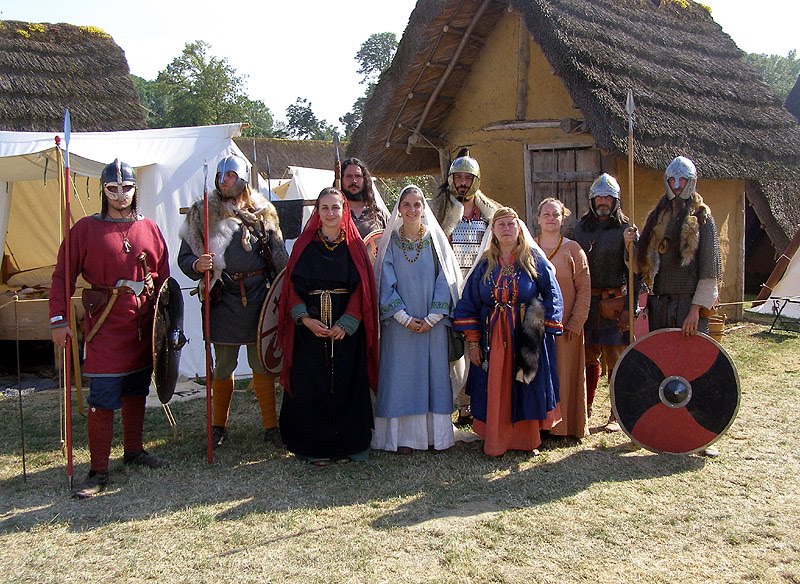
Another curious belief is that the Vikings were superior to the Anglo-Saxons in war. This is not supported by the historical evidence. The Anglo-Saxons and the Vikings were actually closely related as people, sharing a common culture, religion, and similarity of language. They also used the same methods of warfare. Armies were mainly constituted by heavy infantry carrying large round shields and using spears to form shield-walls.
In the 5th century the Anglo-Saxons enjoyed great success in invading Britain. The local people were a mix of resident Celts and a Romanised population who called themselves Britons. The Anglo-Saxons had the advantage of surprise, agility, and manoeuvrability when it came to attacking towns and cities. The local forces were tied to each location for defensive purposes and were not readily able to respond with the required number of warriors. They were also often at war with their neighbours and therefore disunited even before a common enemy. The same was true when the Vikings invaded in 866, only it was the Anglo-Saxons that found themselves on the defensive. The tide turned against the Norse in 878 when Alfred the Great defeated Guthrum the Dane and his Great Heathan Army. A series of significant defeats were inflicted by the Anglo-Saxons, including naval battles and sieges of Viking strongholds. The recapture of York in 954 signalled the end of an organised Norse presence in England.
Later, York was to be involved in two more conflicts of note between Anglo-Saxons and Vikings; the Battle of Fulford Gate and the Battle of Stamford Bridge. It was the loss of the Battle of Fulford Gate that required King Harold to rush north and leave the south of his kingdom undefended even as Duke Guillaume of Normandy planned his invasion. The largest Viking army ever to invade England defeated a smaller Anglo-Saxon force led by two young and inexperienced eorls, Edwin of Mercia and his brother, Morcar of Northumbria. King Harold brought with him an army from the south and surprised the Vikings at Stamford Bridge. The battle was hard fought but the Vikings, led by the Norwegian King Harald Hardrada who was reputedly undefeated in battle, suffered one of the greatest defeats in their history. The fleet that had brought them to England had numbered over 300 ships, but they were only able to crew some 30 of these for their return trip to Norway after agreeing terms with King Harold; so many of their warriors had fallen.
The City of York does very little to represent its Anglo-Saxon heritage, preferring to indulge the Vikings instead. The Roman period is well accounted for, along with the Latin name of Eboracum, as it lasted almost as long as the Anglo-Saxon period that followed it. However, the Anglo-Saxon name of Eoforwic is neither to be seen nor heard within the city walls.
Although I enjoy history, I was myself rather ignorant of the period that used to be referred to as ‘the Dark Ages’, which was the Anglo-Saxon period. It was only when I came to write my Sorrow Song Trilogy of books recounting the three great battles of 1066 that I discovered what a vibrant, interesting, and impressive culture the Anglo-Saxons had created in England. It seems that 1066 weighs too heavily on the history of these people as it also represents their own greatest defeat and the effective end of their civilisation. That civilisation does still live on though. Anglo-Saxon England has a strong influence on modern day England, permeating our laws, customs, and culture. It does not, in my opinion, receive the recognition that it deserves though, and has not as yet found its way into popular culture in the same way that Norse culture has, but I hope that one day it will.
 Peter C Whitaker