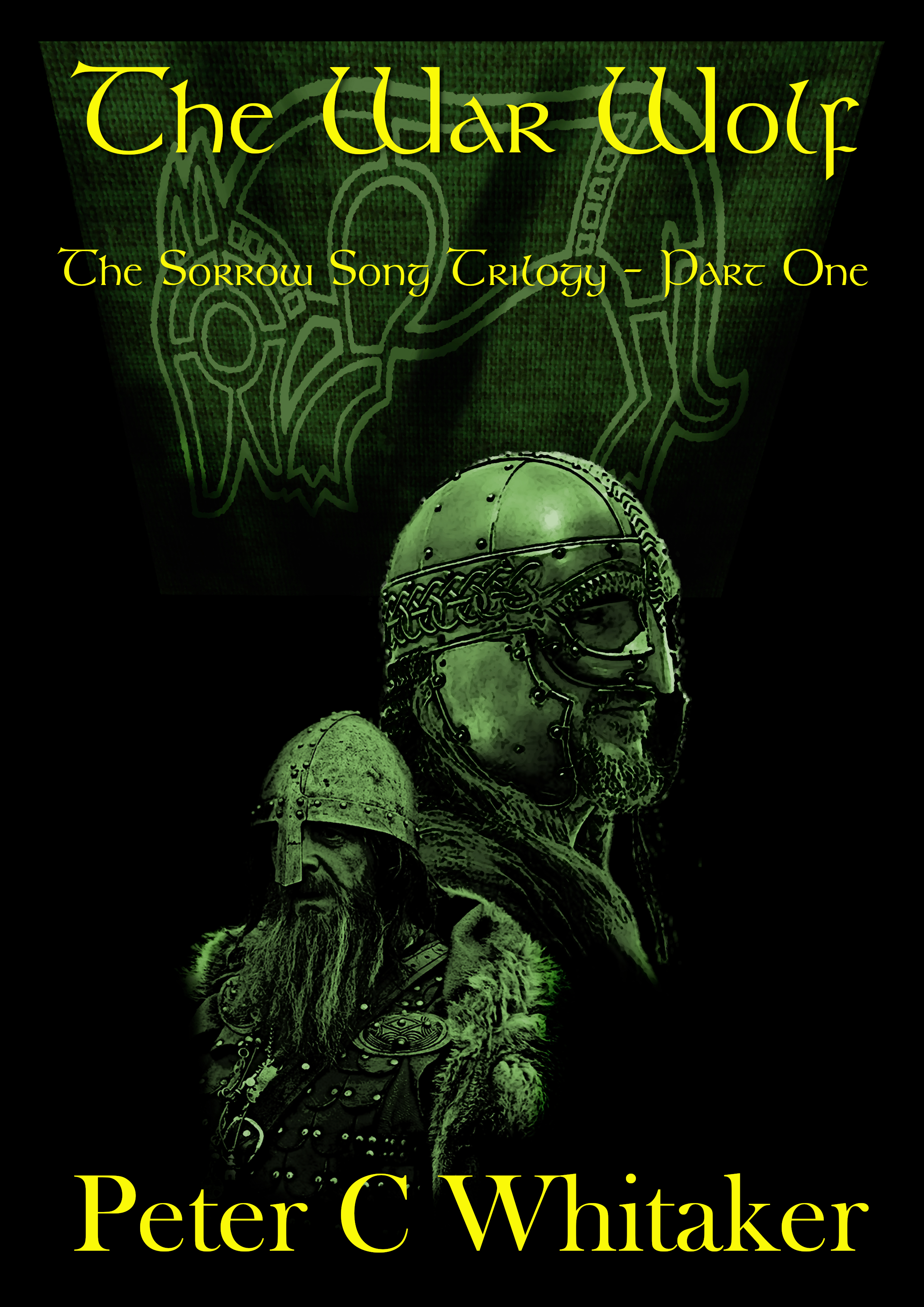
In celebration of the opening of my online digital store, link here: Peter C Whitaker, I am going to offer one of my books at a reduced price for a limited period. This month the book of choice is The War Wolf. It seems only appropriate as it is also the very fist novel that I wrote when I began my career as an author.
The War Wolf is Volume One in The Sorrow Song Trilogy. It recounts the events that led up to the Battle of Fulford Gate near York on Wednesday, 20th September 1066, the actual conflict itself, and then the immediate outcome of the engagement. 1066 is a fateful year in English history. The Norman Conquest is relatively well known but the preceding events are not always presented in detail. When I was a schoolboy the Norman Conquest was taught to us almost as an inevitable event involving the civilised Normans defeating the barbaric Anglo-Saxons. The truth is never that simple in many such cases but, as the saying goes, it is the victors who write the history and it very much suited the Normans to represent themselves as the superior race when imposing their rule over a foreign people in a foreign land.
Another curious fact is that the Battle of Fulford rarely gets a mention in most accounts of 1066. It is often little more than a footnote, but it is the battle that plunged the Anglo-Saxon world into a crisis from which it was never to recover. I expect that the reason for this is that neither of the two main protagonists at the Battle of Hastings, King Harold of England and Duke Guillaume of Normandy, were present. Harald Hardrada, the King of Norway, was the main antagonist. He invaded the north of England with the largest Norse army ever seen. Amongst his numerous allies was Tostig Godwinson, the younger brother of King Harold. Tostig had been exiled only a year earlier by old King Edward, commonly known as ‘Edward the Confessor’, and he had lost the Earldom of Northumbria as well as the king’s favour. Tostig blamed his brother for this turn events but he must have been delighted to discover that his replacement, Eorl Morcar, was present in York with his own brother, Edwin, Eorl of Mercia. Here was a golden opportunity for revenge.
When I realised that there were three major battles in 1066 I knew that I needed a character who could be present at all of these violent engagements and so provide a necessary link between the books. The obvious choice was a Saxon warrior, a huscarl, and so Coenred stepped to the fore. He is not a lord of men, unlike Eorl Edwin or Eorl Morcar, but huscarls were rich and therefore important people. They were members of a warrior elite in that they were professional soldiers. As a character, Coenred is useful in illustrating the many layers of Anglo-Saxon society as well as the strength and danger represented by the fyrd, their army of noblemen, theigns, huscarls, and peasant soldiers.
The Anlgo-Saxons were not illiterate barbarians, theirs was a highly developed, active, and vibrant civilisation that still influences British culture today. Their social life was well organised and the system of obligation between the various classes was well understood. Crimes were punished according to a sliding scale dependent upon the severity of the act and class was not necessarily an means of avoiding sever punishment. Tostig Godwinson discovered this when his misrule of his Eorldom of Northumbria provoked the people to rebel against him, which led to his exile and alliance with their old Viking enemy. Anglo-Saxon women enjoyed much more freedom than their daughters would in the later medieval period. They could own property, keep their own money, and even divorce their husbands. It would be some nine hundred years before they recovered that right again.
Although The War Wolf does concentrate on the Battle of Fulford Gate getting the historical details correct was very important to me. Not only did I research the arms, the armour, and tactics of the time, I wanted to understand the world of 1066. This is as necessary to the telling of the tale as anything else. Such an understanding is important in delineating the characters, both historical and fictional, into realistic people of their time. I am proud that professional historians have praised the accuracy of my representation.
If I have whetted your appetite for my book then please follow this link to the product page where you can down load a digital copy in any of the file formats supported for a discount price 50% lower than normal: Buy Now
 Peter C Whitaker