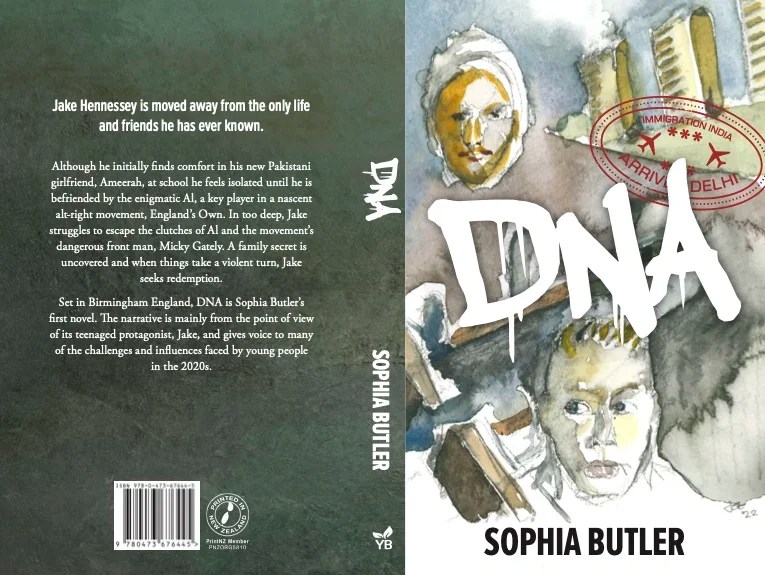
A friend of mine, Sophia Butler, recently commented that her debut novel, DNA, was encountering problems because it contained racial slurs within its text and people were objecting to this. Let me get this point clear at the beginning; the book is about racialism, prejudice, and discrimination. It is set in Birmingham, England. The racist comments are therefore within the context of the story and its themes. They are part of the fabric of the experiences of people who have endured being marginalised by racists. Such comments are part of the pain that these people feel. They may not be the greatest sources of discomfort but they are an integral part of the whole experience of being discriminated against for a reason over which they, the individuals concerned, have no control; that is, being born different to the majority of other people with whom they live.
I have argued against the trend in television and films to misrepresent racial questions, especially in historical settings, as unimportant. Several filmmakers have pretended that there was a golden time in British history when people of colour had an equality of opportunity and treatment alongside white people in our society. This is a dangerous fantasy. It attempts to rewrite social history to represent a more acceptable version that does not cause pain or discomfort to those viewing it. This approach also minimalizes the pain and suffering that the victims of racial abuse have endured throughout history, and that to me is far more insulting than any vocal slur.
The lessons of history are painful because people have done terrible things to other people. Perhaps this is why we do not appear to want to learn those lessons today. In a society that obsessively creates safe places for people to indulge their individual idiosyncrasies, places where pain and offence do not intrude, fact is devalued and fantasy encouraged. One of the painful lessons of history is that western society has been, and still is, prejudiced against people of colour. It is an established fact and one of the causal agents of the creation of the ‘Black Lives Matter’ movement. This is also where the contradiction arises, however, with the fantasists’ misrepresentation of social history. Issues like racism are either important or not important. It is a question of logic; a thing either is or it is not. We cannot have it both ways.
To many people today the question of race, when used to discriminate against an individual or a group of people, is both an important issue and an objectionable fact of life. There is a wealth of empirical evidence to support this stance. Acknowledging its existence in our society is painful, not just in terms of our social conscience, but also as individuals; especially if you feel any kind of empathy for another person. Pretending that history was once somehow different does not make the problem go away. Neither does putting it in a box, sealing it, and then ignoring it. Racism has existed, still exists, and will continue to exist until it is successfully confronted. Censoring an author’s work because it includes racial slurs to emphasise the arguments against racism does not confront the problem, it avoids it. I would go so far as to argue that this behaviour also supports the continuation of prejudice and discrimination of peoples in our society as a consequence.
There may well be some people who are able to put the thorny subject of racism in a box and think of it as both existing and not existing at the same time, a bit like Schrodinger’s cat. However, the whole point of that mental experiment was that the true nature of the subject’s existence, be it the cat or a social issue like prejudice, could only be known if the box was opened. Authors like to open the box and examine what they find; often no matter how painful that might prove to be. Nothing beautiful is created without pain. In life there are no safe spaces. Problems are not solved by being avoided. They may well appear to no longer to exist to the person who avoids them, but to the people who suffer those problems they remain very much a painful reality. Unfortunately, we seem to live a society that expends a lot of energy on attempting to promote fantasy over reality so as to avoid the pain inherent in living. As Johnny Cash observed, ‘I focus on the pain, the only thing that’s real’. The truth is often painful and we would be poor artists if we avoided it just to spare another’s feelings, but then they would probably argue that ignorance is bliss!
I will be writing more about the book, DNA, in future posts. For more details of Sophia Butler’s work, both her novel and her excellent poetry, please use this link: Sophia Butler.com
 Peter C Whitaker