The falsification of history has done more to impede human development than any one thing known to mankind.
Jean-Jacques Rousseau
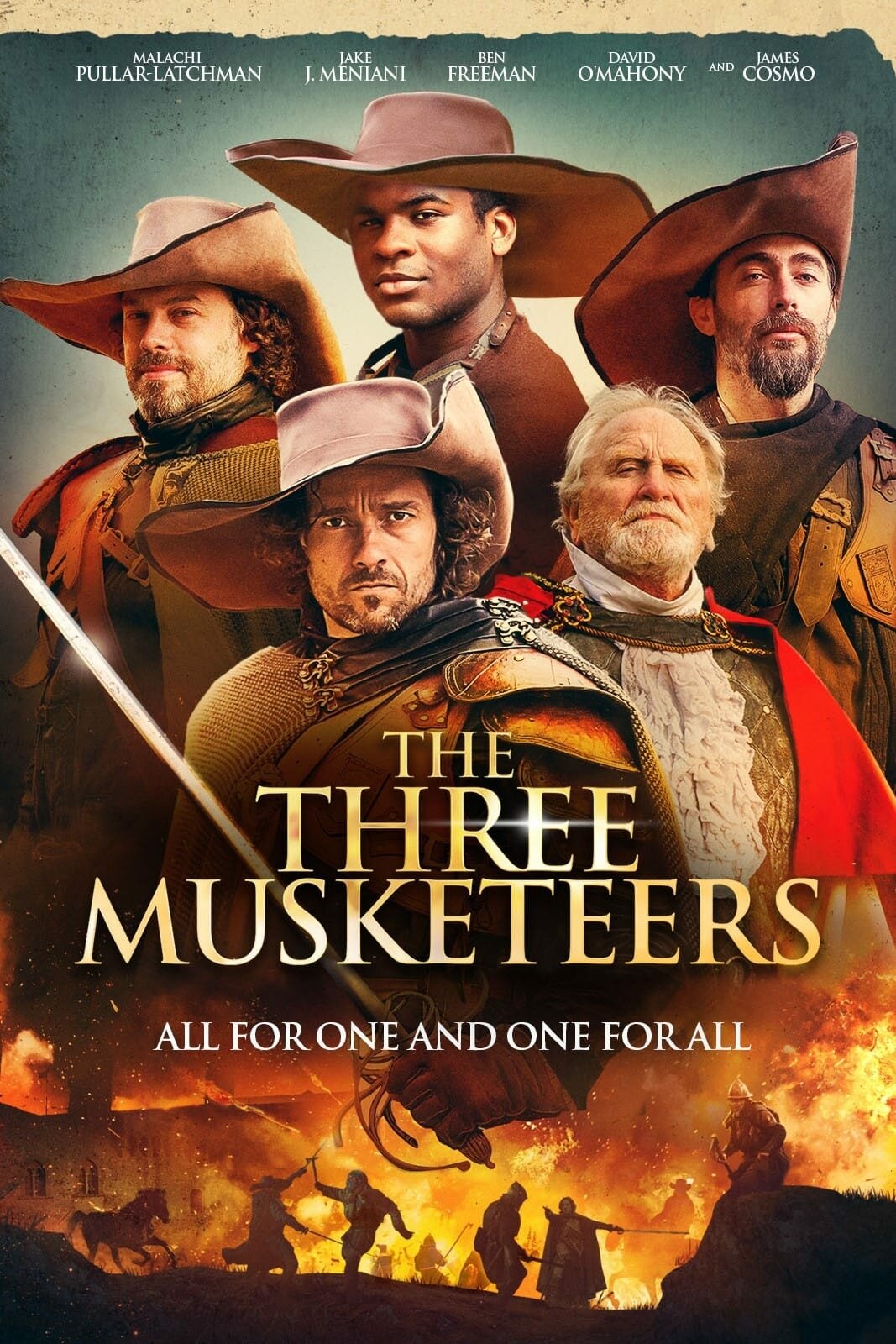
The Three Musketeers is one of my favourite books. It set the model for all great adventure stories, introducing the idea of the young hero teamed with older mentors, a long and dangerous journey, notable villains, and a glorious mission to complete. The story itself has been made into over eight major films productions, many television and stage productions, cartoons, comics, and even video games. Not all of these had been particularly good or even faithful to the novel that inspired them, which seems to be an accepted failing of popular media in relation to historical fiction; even when it concerns real people. In this respect, I am not just talking about the obvious historical characters, such as King Louis XIV or Cardinal Richelieu, but Charles de Batz de Castelmore D’Artagnan, more commonly known as just D’Artagnan; he was a real person.
The above poster is from a 2023 production by Picture Perfect, a company that has previously made such films set during World War 2, the mediaval period, and even Roman Britain. They seem to prefer historical dramas, however, they do not appear to consider representing the past as faithfully as possible as an important consideration. In their version of Alexander Dumas’ The Three Musketeers they cast Malachi Pullar-Latchman, a coloured actor, as D’Artagnan, a man who was not known to be coloured himself.
There are some interesting facts about Alexander Dumas, the author of The Three Musketeers, such as, he was an obsessive researcher of historical fact; it was in some obscure manuscripts that he discovered the life and times of D’Artagnan, and Dumas himself was of mixed race. His father, Thomas-Alexandre Dumas Davy de la Pailleterie, was born on the island known today as Haiti to a French nobleman, Alexandre Antoine Davy de la Pailleterie, and an African slave named Marie-Cessette Dumas. Despite his mixed parentage, Thomas-Alexandre would go onto attain the rank of general in the French Revolutionary Army and fought under the command of Napoleon Bonaparte. Alexander Dumas did not follow his father into the military but became a highly successful writer, his work not restricted to historical novels but including travel books, he travelled widely himself, plays, and magazine articles. He founded his own newspaper and even a theatre. Alexander Dumas collaborated with another researcher, Auguste Maquet, in his historical novels and they both took their work seriously. At no point do either of them suggest that D’Artagnan was not white, which he might have been tempted to do if the evidence supported it, not least in consideration of his own parentage. As there is no proof to suggest that D’Artagnan was not caucasian why would a coloured actor be cast in the role of that particular historical character?
Discussing race issues can be difficult because people often get emotional about it. Nevertheless, in this context I think that it is important because popular culture has done a lot of damage recently to the honest representation of coloured people in European history. I have written previously using a number of film and television dramas in which coloured people are inserted into social settings where they would never be found historically. One of the reasons why I object to this is that its general acceptance in popular media, and by extension our wider society, both dilutes and disrespects the much greater suffering of people of non-white races in those times. It is estimated that twelve million people were sold into slavery between the 16th and the 19th centuries, and that some 1.5 million of them died while in transit. Pretending that a person of colour could occupy a social position or undertake a noted profession in the strict European social hierarchy of the time is an insult to the suffering inflicted by the Atlantic Slave Trade on people of the same race.
There is also the question of hypocrisy. If it is acceptable for a coloured actor to play a non-coloured historical character is it also acceptable for a non-coloured actor to play a coloured historical character? Let us use the example of General Thomas-Alexandre Dumas Davy de la Pailleterie, who was classed as a Creole and known as Schwarzer Teufel, Black Devil, by the Austrian troops that he fought in Italy; would it be acceptable for a non-coloured actor to play Thoams-Alexandre in a proposed historical biopic of his life? Logically, to avoid being hypocritical, the answer has to be yes. However, as someone who values history and writes historical fiction, I oppose the acceptance of the proposition on the grounds that if race is important then the history of all people of a specific race is also important. The wilful misrepresentation of that history, either to fulfil a current social-political agenda, or simply to make a media production more appealing to a mixed race audience for commercial reasons, is damaging. It does not help improve race relations, or reduce prejudice and discrimination. I believe that it does the opposite as it creates a delusion that hides what some people today seem to consider to be unpalatable facts.
The study of history is frequently uncomfortable, even objectionable, because it reveals what the human condition has been capable of in the past, resulting in holocausts, genocides, and the mass destruction of civilisations. It is not supposed to be a fairy story where everyone got along like the best of chums; it is supposed to help us improve ourselves. Any conscious misrepresentation of the facts, even misguided instances, does harm, not good. I will finish with another quote, this time from Eleanor Roosevelte:
I believe you should tell the story of injustices, of inequalities, of bad conditions, so that the people as a whole really face the problems.
 Peter C Whitaker