My wife surprised me with a suggestion that we had a holiday in Poland. Her main reason for this was discovering that the flights were rather cheap. After I agreed she proceeded to plan an eleven day trip that started in Poznan, followed by visits to Gdansk, Warsaw, and Krakow. I mentioned that we could not ignore the opportunity to visit Auschwitz and she agreed, so we booked tickets before we left England. The website suggested that we join a tour group conducted by a guide who could speak English.
The journey from Krakow to Auschwitz took approximately 1 hour 40 minutes on a regular bus that ran from the city centre bus station to the entrance of the visitor centre itself. This is an excellent means of getting there, although there is a train from Krakow to the nearby town of Oświęcim, from where you can catch a shuttle-bus to the visitor’s centre.
On arriving at Auschwitz we found a large number of different parties and no real direction as to what to do next. Fortunately, many of the people working at the visitor centre speak excellent English and after asking we were told to just go straight in. The tour itself takes about three hours and includes a trip to Auschwitz II, also known as Birkenau, which is some three kilometres away but a free shuttle-bus is provided. Once our tour group started I immediately noticed that there is no provision for disabled people. There are lots of steps and most of the ground that is walked over is uneven. I found it difficult going and was glad that I had brought my Ta-Da walking stick that folds out into a small chair. Quite often I used it while the guide was talking. However, the fact is that disabled people with mobility impaired more severely than mine will probably not be able to visit Auschwitz.
When I posted this comment on social media several responses suggested that the Nazis had not intended it Auschwitz to be accessible to disabled people. That is probably true, but the camp today does not exist to fulfil the function that the Nazis intended when they converted what was then a barracks for a Polish cavalry regiment into a concentration camp and, later, a death camp. Our guide told us that throughout its use by the Nazis the camp was changed and adapted to use almost constantly. This made me wonder why it has not been further adapted to allow disabled people to visit it today. Only a small number of the buildings are open to the public so any changes to them to allow disabled visitors access would not change the camp itself to any marked degree. In one of these buildings there is an exhibit, upstairs ironically enough, of some of the orthotic equipment taken from inmates who were killed in Auschwitz. The number of these victims is estimated at 100,000, but our guide told us that the real figure is probably much higher as the Nazis did not bother keeping an accurate account. Although the disabled were amongst many other groups that were sent to death camps like Auschwitz the real focus, and that of historians afterwards, has been on the murder of the Jewish people, but the fact is that the enforced euthanasia of undesirables began in September 1939 with the German population of disabled people, more of which you can read here: Life Unworthy of Life – The Euthanasia of the Disabled in Nazi Germany | Peter C Whitaker
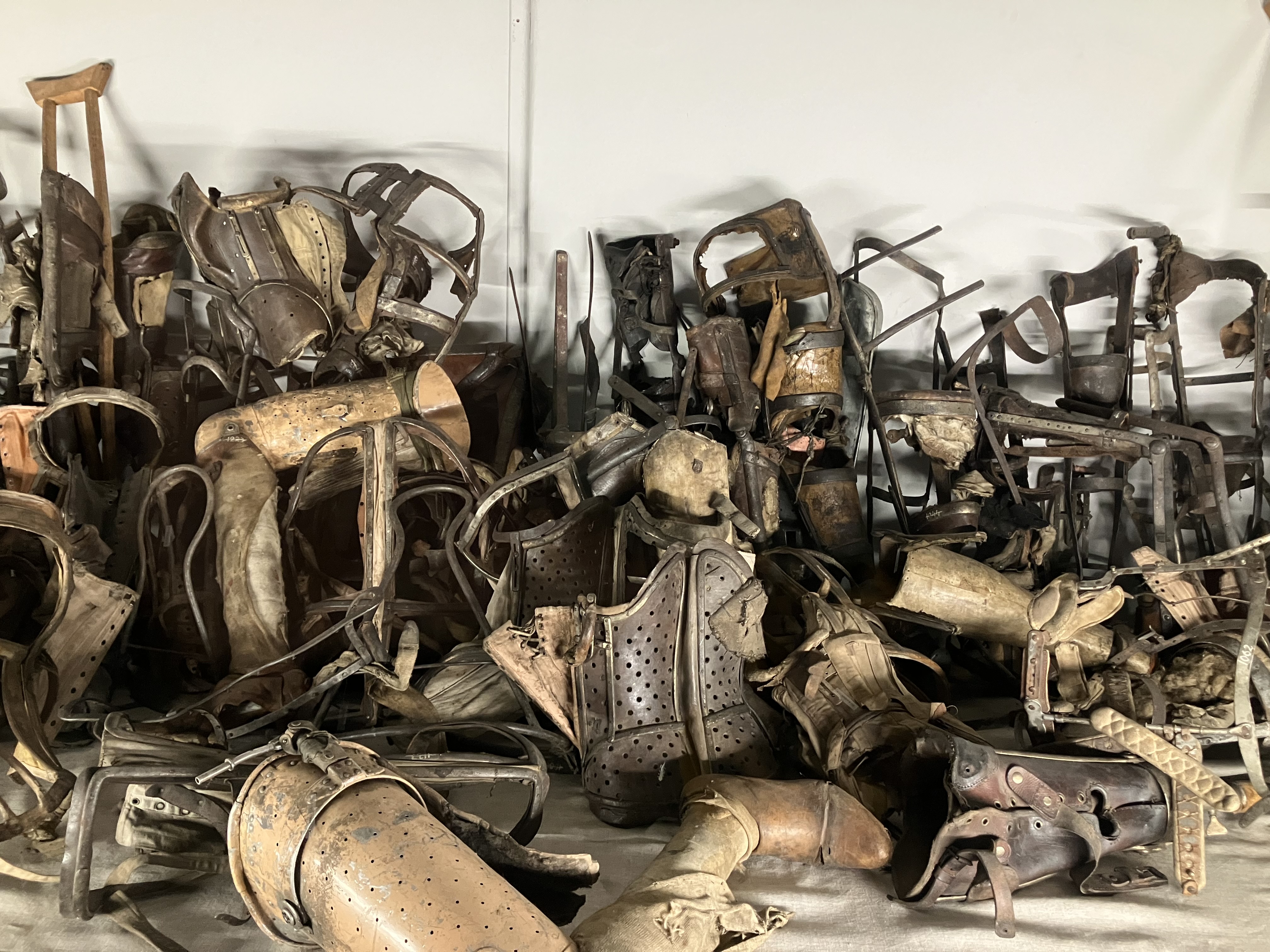
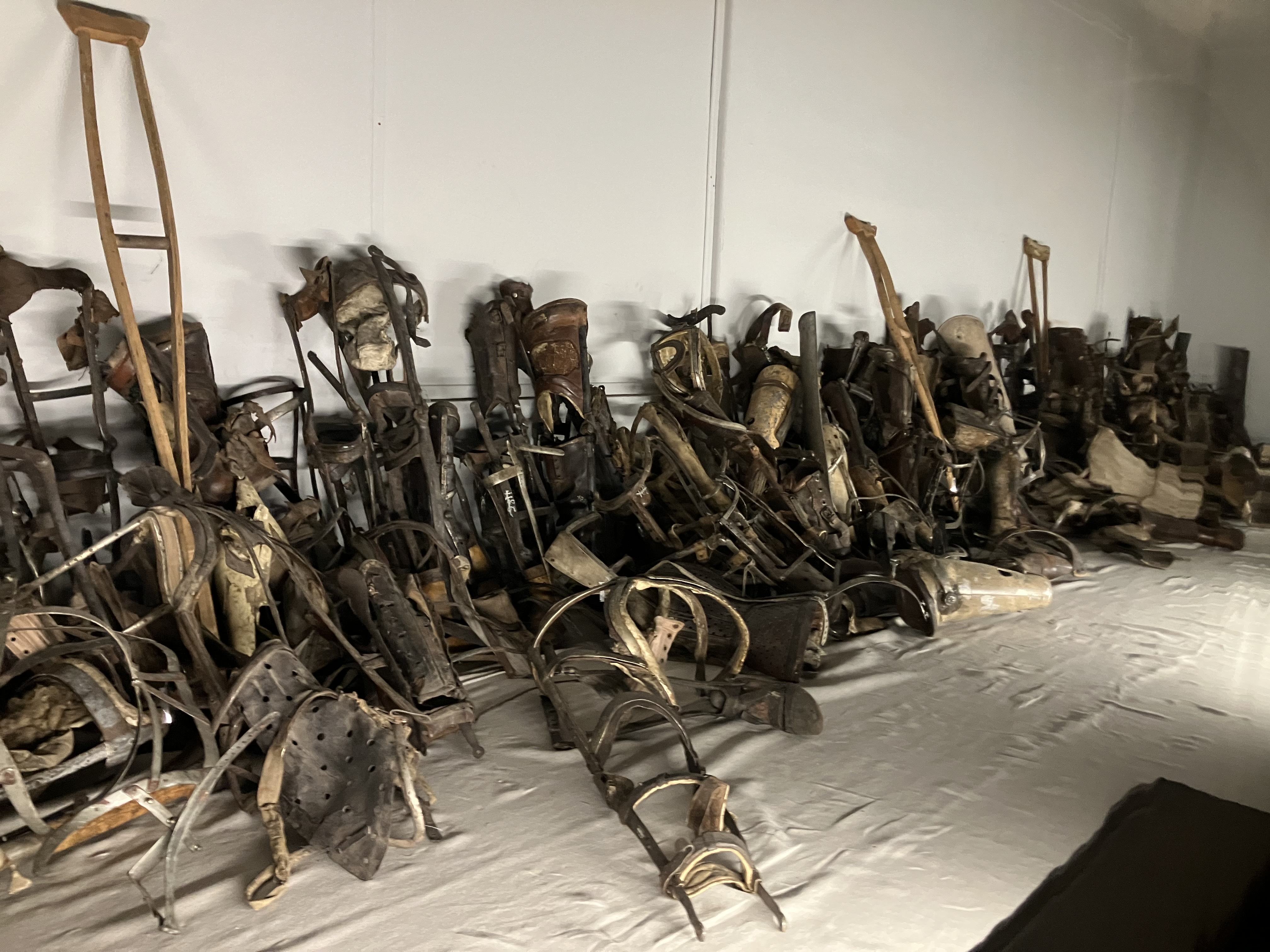
I found it profoundly disappointing that there is no provision for disabled people to come to Auschwitz and pay their respects to the victims who died there. The place continues to exist today as a reminder of the atrocities that one group of people can commit on another, but it fails to do that to its best intent simply because the Auschwitz Memorial and Museum, the organization that maintains the camp today, have not thought to include disabled people even though they are amongst the victims who were murdered there.
 Peter C Whitaker