This is a book that I have wanted to read for a very long time and I have to admit that it disappointed in only one respect; the ending. In every other regard this is a very immersive and compelling read.
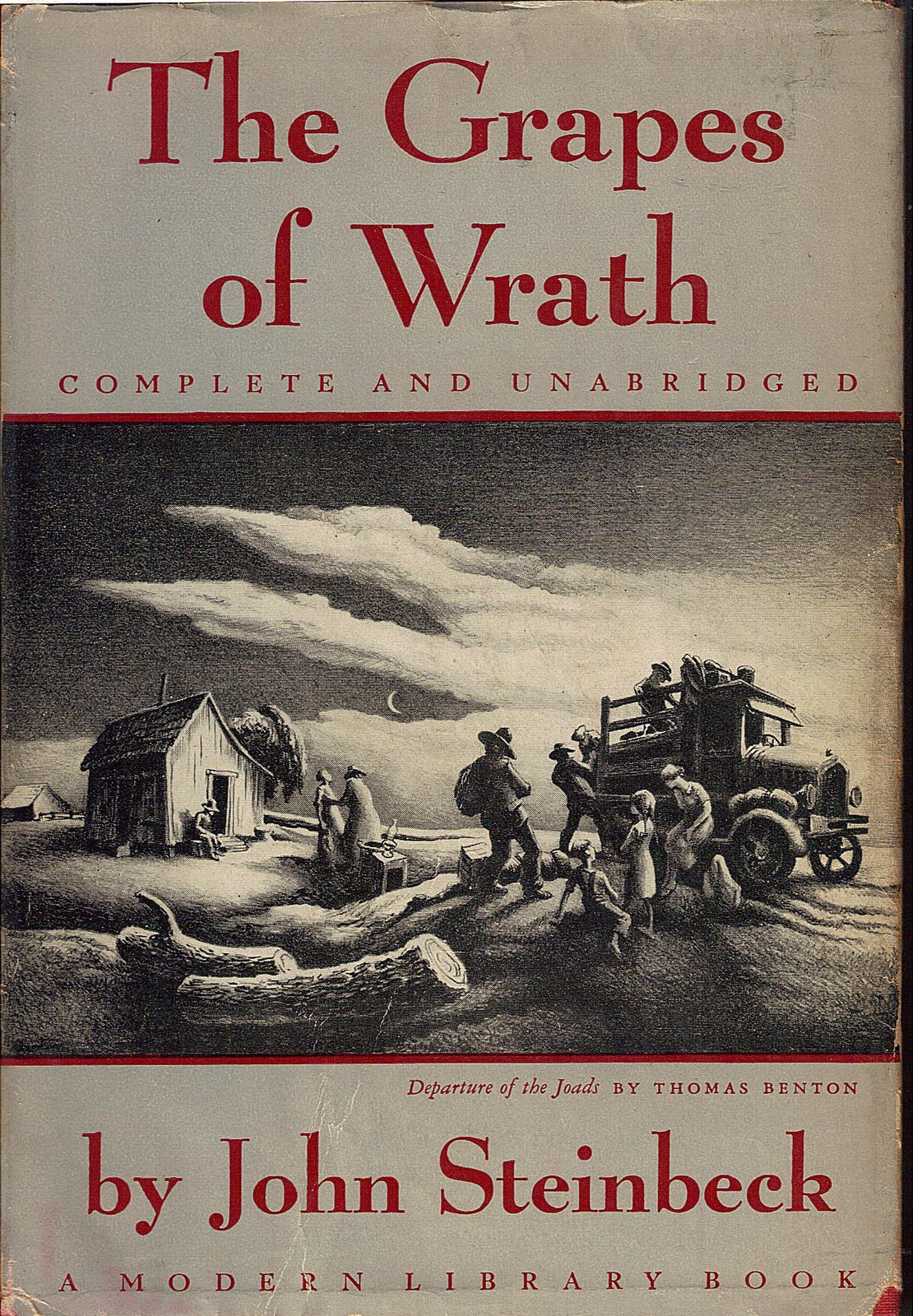
Set during the Great Depression, The Grapes of Wrath opens with the return of Tom Joad, the protagonist, to his family in Oklahoma after being paroled from prison. He has served a sentence for manslaughter after killing a man who attacked him with a knife, and he has been released on licence due to his good behaviour as a convict. What he comes back to, however, is the family home and farm that has been abandoned. The downward spiral of failed crops, the Dust Bowl phenomenon, and the economic crash, has resulted in many small farming families like the Joads losing their land to the banks, leading to a mass migration; many of them heading west to California after they are misled into believing that there is plenty of work there for them.
Steinbeck’s style of writing is immediate in bringing the reader into the world of poor but proud working people. The dialogue is unapologetically couched in their language, using terms that are unfamiliar, but not difficult to understand or translate. With nothing to keep them in Oklahoma, the Joads set off on an epic journey west, looking for the promised land, but finding nothing but intolerance, violence, and oppression. The once proud family that was bound with strong ties starts to fragment, beginning with the death of Grandpa Joad who did not want to leave Oklahoma, and later his wife, Grandma Joad, as the family cross the Mojave Desert. The representation of prejudice against the migration of dispossessed people from the east is graphic and often inhumane. There is very little consideration for them, or understanding of the causes of their plight; they have become a people to both exploit and demonise by the residents of California, and that is exactly what they do.
Tom Joad rises from his position as second eldest son to become the head of the family. He is always deferential to his father, showing the kind of respect that would have been expected, but he can see that his Pa has been broken by his recent experiences, and has given way to his wife in most things. Tom’s mother initially assumes the position of matriarch, but she cannot do everything, especially the tasks that traditionally fall to the men, so Tom unconsciously steps into his father’s boots. He is not always confident of his own abilities, however. Becoming the titular leader of the family, he often chooses not to give the advice the others look to him for, and avoids imposing his will on them. He freely allows his older brother Noah to leave them just so that he can follow a river when they reach California. That said, Tom is always looking for ways to improve the family’s lot; his loyalty is never in question. It is his decision making that eventually leads to him failing everyone, and yet in that he is not entirely to blame. The Joad family is constituted by people who are either too young or too old to deal with the situations that they find themselves in, which results in them pinning all their hopes on Tom, who tries to succeed but does not feel himself best placed to carry the weight of the obligation.
After an interval at a government run camp the family follow yet another dream, heading north to pick fruit, and despite an initial success, they soon experience the trap of being working people living in poverty. The wage that they are first offered for their labour is soon cut to a level that barely sustains them, and they are mercilessly exploited by a cruel system that requires them to spend their hard earned money at the grocery store owned by their employer. Steinbeck is implacable in illustrating the crushing weight of a social system in which the poor are often sacrificed for the profits of the wealthy. The denigration of basic human dignity is unremitting, and the collective persecution of a powerless people, up to and including their sanctioned and justified murder, by a callous and unforgiving established society that considers itself civilised leads the book to its conclusion. Tom is separated from his family when he kills a man after both he and his friend Jim Casy are attacked for trying to organise a resistance to the people exploiting them. The fact that Tom only acts after Casy is murdered in no way exonerates him in the eyes of the local law, who do not care about Casy’s fate; they want Tom in order to make an example out of him in order to crush the spirit of anyone else who might try to resist. What local authority fears most is an organised body of migrant working people establishing itself because they know where the true power would then lie.
It is Tom’s action that brings the book to its less than satisfactory conclusion. He fades from view as the family move onto yet another location that, like the others before it, appears to offer some hope, but this is all washed away, literally, by the coming of a storm that rages on for days. The Joads have become even more fractured, reduced to their smallest number yet, especially with Tom’s departure. The storm forces them to abandon everything, even their vehicles that are rendered useless with flooded engines, and take shelter in a barn on a hill. It is clear that their plight is going to continue beyond the last page of the book, and that there is no expectation of it ever being alleviated. I found the last act, their attempts to save a man dying from starvation, confusing. It suggests that the family’s moral values have not yet been abandoned, which is redeeming, but that they have become a pathetic group, a collection of people no longer able to determine their immediate future, or find any kind of leadership from within their own ranks. Perhaps the very sudden ending that offers no resolution to the story is exactly what Steinbeck planned, although to me at the time of reading it I felt that he did not know how to end the tale of the Joads. Despite this criticism, The Grapes of Wrath is an excellent read. The themes are dark and unremitting, following the slow crushing of working people by an economic system that rolls over them, promising nothing but destruction, and the callous condemnation of a society that escapes the same fate by virtue of having a few dollars in their pockets and the delusional belief that the same could never happen to them.
 Peter C Whitaker