There is a difference between an ‘opinion’ and an ‘informed opinion’, the former is not necessarily supported by any evidence, that latter is. It is not difficult to find examples of ‘opinions’ in social media, there are probably the most common posts made. Reading an opinion that has been informed by the writer looking for evidence to support it is much rarer.
I have seen many people claiming that Covid-19 is a deadly disease, but the facts, I believe, do not support that assertion. Here are some simple statistics taken from the source that has been used by the British Government(1) as of 27 May 2021.
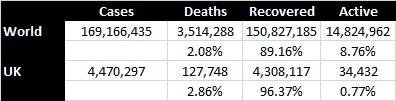
Table 1: columns 1 to 4 list the reported instances for each heading. The rows beneath ‘World’ and ‘UK’ give the numbers for columns 2 to 4 as percentages. For both the World and the UK the mortality figure is less than 3%. For both the World and the UK the recovered figures are significantly high and that for active cases is actually quite low.

Table 2: compares the Covid-19 statistics against both World and UK population totals. The figures for the UK are higher than those for the World population in respect of Cases and Recovered. The mortality rate drops significantly in both instances.

Table 3: illustrates the number of deaths reported for the World Population as 0.30%, of which Covid-19 reported deaths account for 15%, which equates to 0.045% of the total figure.
There is a problem in using these figures, however. The World Health Organisation (WHO) use the following definition for recording Covid-19 deaths:
‘A COVID-19 death is defined for surveillance purposes as a death resulting from a clinically compatible illness in a probable or confirmed COVID-19 case, unless there is a clear alternative cause of death that cannot be related to COVID-19 disease (e.g. trauma).’(2)
Note the term, ‘surveillance purposes’. The figures reported for measuring deaths related to Covid-19 are not meant to be accurate, but rather to give an indication of the progress of the virus. Public Health England (PHE) count all deaths in people who have a positive Covid-19 test. They combine the fact of a death with the fact of a positive test to derive a total and report it as a Covid-19 fatality. However, PHE accept that the total can only ever be an approximation because not everyone who dies has, or never has had, a positive Covid-19 test. Only those cases that return a positive test result for Covid-19 within 28 days of dying are recorded. In some cases, Covid-19 may not present until after the 28 day point, but these go unrecorded. Using the WHO’s definition above it would be more accurate to label such instances as ‘dying with Covid-19’ rather than ‘of Covid-19’.
Is Covid-19 a deadly disease? This would appear to be open to interpretation. It is certainly a disease and it is certainly able to cause someone’s death. The context in which the phrase is used is obviously important. WHO do not rate Covid-19 in their list of the top 10 causes of death worldwide(3). Ischaemic heart disease is number 1, resulting in 16% of the world’s total deaths during 2019. This figure is significantly larger than the 0.045% reported for Covid-19. The fact is, however, that people appear to be terrified by Covid-19. I have no doubt that this is due to the manner in which it has been consistently reported in mainstream media, which tended to use statistics for infection rates and deaths, but often ignored recovery figures, resulting in an imbalance in the presentation of the facts. The imposition of lockdowns, wearing of masks, and distancing people from one another in social environments has probably added to the paranoia. This has certainly seen a rise in mental health concerns, even in people who were not previously diagnosed with such conditions(4).
In conclusion, I do not consider Covid-19 to be a deadly disease. If you combine the figures from Worldometer for deaths caused by smoking, 2,007,025, and alcohol, 1,004,146, you get a total of 3,011,171 fatalities, which is only 503,117 less than the total fatalities for Covid-19. Smoking and drinking are known to be harmful to a person’s health, but neither are represented to the general public as ‘deadly’. Covid-19 is a harmful disease, but it appears to have provoked a worldwide response that, in my opinion, is out of proportion to the level of threat that it truly represents.
To underline my conclusion, the British Government declassified Covid-19 from its list of high consequence infectious diseases (HCID) (5) on 19 March 2020, the day before the first UK lockdown.
References:
- Worldometer: Coronavirus
- Public Health England: Behind the headlines Counting COVID-19 deaths 12 Aug 20
- World Health Organization: The top 10 causes of death 9 Dec 20
- The Lancet: The mental health impact of the COVID-19 pandemic on people with and without depressive, anxiety, or obsessive-compulsive disorders: a longitudinal study of three Dutch case-control cohorts 01 Feb 21
- Gov.UK: High Consequence Infectious Diseases (HCID)
 Peter C Whitaker
You present quite a convincing argument based on comparing carefully selected statistics; and the list of sources at the end gives the impression that this is a scholarly paper intended for publication or consideration as an assignment in a degree program. My speciality isn’t maths or statistics but I suspect that a qualified person would be very critical of the way you have used charts and statistics here.
Leaving that aside, if you personally choose for whatever reasons not to define Covid-19 as a ‘deadly’ illness, that’s fine (even though in the piece above even you concede that people do die from it). It does seem to be a matter of semantics from your point of view and in that you are of course free to come to your own conclusions and semantic formulas.
If I had been living on the dark side of the moon for the last few years, completely out of contact with Earth, I would probably find what you say above quite reasonable. However, to anyone living on Earth since 2020, what you have written above would seem to indicate a profound blindness to the realities most people on Earth are living with…
Even in the richer and better organised western world, health services have been pushed close to collapse by the sheer number of people taken seriously ill by Covid. In poorer and less well organised countries such as India, health services actually have collapsed and people have been left to die in the streets. Entire economies of rich and poor countries, right wing and left wing governments, have been closed down for months on end. People around the world have lost their jobs and their livelihoods. Moreover, a lot of people who, according to your statistics have ‘recovered’ from Covid, are still suffering long term symptoms and may never be able to resume their old lives.
So whether you personally (or anyone else) choose to define Covid as ‘deadly’ or not is a fairly insignificant fringe issue that does not really confront the realities of the actual Covid crisis in any way at all.
LikeLike
leonie666, an essay that does not use references is an opinion piece, which is fine if that is the intent of the author. I used various objective facts to base my argument upon. The inclusion of references gives the reader the opportunity to check those facts for themselves if they so wish. It is how I learnt to write factual pieces while at college.
If you check Reference 1 you will see that the statistics chosen for use in the tables are produced by the World Health Organisation, which are in their turn used by various governments. If the data is incorrect then the criticism should be levelled at the originator, not the user. A person may be critical of the simplistic way that I chose to represent the data, whether they are a specialist or not, but that does not constitute a challenge to the veracity of the data itself.
The reasons why I do not consider Covid-19 to be a ‘deadly disease’ are all contained within the article and are based on the facts represented therein. Do you have any contrary facts with which to challenge my conclusion?
Semantics is actually a very important subject as it deals with the meaning of words. You might not like or agree with the way I write, but using the phrase ‘matter of semantics’ is meaningless. It does not challenge the meaning attributed to the words or the validity of the argument constructed by their use. You are just making a dismissive statement that is itself not based on fact or logic.
As suggested in the title, the essay examines whether Covid-19 is deserving of being considered a deadly disease. I took the fact that some people do consider Covid-19 to be a deadly disease as my starting point, as clearly stated in the second paragraph. However, the criteria used are clearly set out and they do not include the reactions of people, either as individuals or governments, as part of that process of classification; although it does appear to be a consequence of its conclusion. Whether that makes me profoundly blind or not is both spurious and subjective in that context.
India is not a poor country. It has both a nuclear program and a space program, and is resident to over 100 billionaires. Like many other rich countries, it has a large proportion of poor people, but its poverty rate of 6% is lower than the USA’s, which is 10%.
How a disease is classified is not a fringe issue in either science or government controlled healthcare. The process of classification is used by governments to inform their response strategies. It would be reasonable to expect that a disease classified as deadly would be given a higher priority over one that was not.
However, if you genuinely believe that the classification of Covid-19 is a fringe issue then why did you respond to this piece at all, as doing so suggests that it is actually a matter of importance to you at least?
Nothing that you have written challenges either the logic of my argument or the facts used to underpin it.
LikeLike
https://en.wikipedia.org/wiki/Essay
LikeLike
Leonie, seriously?!
LikeLike
What do you want me to say? I’m trying to avoid being rude or confrontational. Your way of making an argument is not the only legitimate way. That’s all I’m trying to point to.
LikeLike
How about confronting the facts rather than the style of presentation? The argument should be the discussion.
LikeLike
“How about confronting the facts rather than the style of presentation? The argument should be the discussion.”
Goodness Peter, I wish you would take your own advice. When I come up with an argument you dismiss it because I don’t write in the same style as you or quote the same facts as you. If I quote facts or provide links, you dismiss the facts and rubbish the links. Yes, I am guilty of that too because the whole point is that facts and sources can always be disputed. That is why I prefer to go by argument alone when possible and rely on evidence that is common to all.
There is plenty of evidence available to all of us including you that covid is deadly to some and a huge problem for practically everyone. As I said before, whether you or others choose to define Covid as deadly or not is an irrelevance to the reality many people are experiencing.
I personally know one person who died of it and several people who became seriously ill (one of them still is). Virtually everybody I know has had their life turned upside down by the pandemic.
The things you write on this topic are very hurtful to the bereaved and insulting to the majority of people who are trying to deal with the everyday problems coronavirus is forcing us to live with. Have you ever considered that?
And if you have, then what is it you are trying to achieve in your various posts and writing about the coronavirus pandemic?
LikeLike
Leonie, you choose to approach this topic from an entirely subjective and often emotional point of view. It appears to me that many other people do also. I was trained to research facts to support an argument and present it in a logical fashion. In writing the blog post above, I began by questioning a claim by a friend of mine that Covid-19 is a deadly disease. All the evidence that I found contradicted that statement. If I had found anything that offered an alternative interpretation then I would have explored it, but I did not. I would be happy for someone to reveal such evidence to me.
The argument might appear technical but the details within it are those used by politicians to justify their response to the pandemic, and it is their decisions that have hurt people the most, not the disease itself. As I have written previously, people have died because treatments for other potentially deadly conditions, such as cancer for example, were cancelled or postponed due to medical resources being diverted to deal with Covid-19. That, to me, makes the classification of any disease an important issue.
I am sorry that someone you knew has died of Covid-19. I myself have not personally known anyone who has, but I have known a lot of people who have died of cancer. Cancer is a deadly disease. Not so long ago it was stated that 1 in 3 people would develop it within their lifetime, today it is 1 in 2. The survival rate for cancer is approximately 50%. The sooner the disease is diagnosed, and treatment begun, the better the survival rate, but in the past 18 months cancer patients have been sacrificed in response to decisions made by politicians and hospital managers; that is something that people should be angry about.
My reality of Covid-19 is that I have had it and suffered no ill effects. So has my wife. Another person’s reality is probably different. Although I accept that all experiences are valid, I often find other people do not. This seems to be because it is contrary to their interpretation of the facts. However, I also find that many people simply do not question those same facts; they simply accept what they are told. To me, this is apathetic, and apathy is one of the greatest social evils.
In science, scepticism is a tool for getting to the truth. The truths that we do know are in those arguments that prove robust enough to survive questioning. To quote Carl Sagan, ‘if it can be destroyed by the truth, it deserves to be destroyed by the truth’. To do that, however, you have to begin with a question. My experience of Covid-19 has led me to challenge the interpretation presented in the mainstream media by politicians, both here in Britain and in other parts of the world. I do not find the evidence used to support the popular interpretation of facts to be robust.
Today, many people appear to live in fear of a virus that has a very low mortality rate. Its most significant feature is its rate of transmission. There are over 10,000 diseases actually classified as ‘deadly’ in the world, but only 500 treatments for them. I have to question why a disease that is not recognised by government and world health authorities as being one of those deadly diseases has been allowed to disrupt our lives in such an unprecedented fashion. If people do find what I write hurtful or insulting then they are free to take me to task, but I did not create the situation in which we now live, I am just choosing not to accept it at face-value.
My final comment goes to Mark Twain: the truth hurts, but silence kills.
LikeLike
Peter, I will start by acknowlediging that I pobably can’t win this argument with you. Not becuase you are right but because we seem to be speaking different languages despite conversing in English.
You state that I write from a subjective and often emotional point of view. I do not deny that at all. However I do not see that as being something which invalidates what I say. I think my argument is holistic and is based on a mixture of factual evidence, subjective experience.
Your argument is also subjective and is coloured by the fact (as you state above) that neither you nor your wife suffered much as a result of exposure to covid.
Let me try and make something clear. I am fully aware that the vast majority of people who come into contact with Coronavirus will not get seriously ill. Some people will not have any symptoms at all. I do fully know and understand this.
There is a side to the pandemic which you and others don’t seem to understand at all; although you do refer to it…
You spoke about the seriousness of Cancer and the fact that fatalities from this (and other deseases) have increased during the pandemic.
This is the point Peter!
The reason more people are dying from other illnesses is because hospital beds are taken up with people who have acute Corona symptems. Because covid is very contagious hospitals have to completely reorganise and people with other conditions cannot be treated. Instead, in ALL countries where the pandemic has hit, there are now huge waiting lists for both routine and non emergency proceedures. Some people who might have cancer and other conditions have not even been tested because the capacity isn’t there.
But as long as one wave of coronavirus is followed by another wave of coronavirus, this will continue to be the case.
The way to break this chain of events is by limiting the spread of coronavirus and vaccinating as many people as possibe. These two strategies will reduce the number of people admitted to hospital with covid. That will free up beds and allow hospitals to return to treating people in the way they were able before the pandemic.
Covid is not in itself as ‘deadly’ as cancer or as some other pandemics of the past. However that has never been the real danger of this pandemic. The real danger is that it incapacitates our health services partly because of the very fact that a lot of people don’t even know they are carrying and spreading the virus. It is the contagiousness that is the problem and beyond the impact on hospitals and health services there is a knock on effect on the economies of all countries BECAUSE OF THE DAMAGE TO HEALTH SERVICES.
Do you have another solution?
It seems to me that even the most corrupt and selfish governments in the world such as Brazil are realising that just letting people die cannot be a solution.
.
LikeLike
As part of my academic training I was taught to write an argument in a structured fashion using evidence and reason to support the points being made. I always research the facts of the topic first and list the sources as references if I think it is appropriate. Of course, a subjective interest in, or personal experience of, a particular topic is always the starting point, but the aim is to present an objective piece that can withstand scrutiny.
In discussing the status of Covid-19 as a deadly disease I limited the essay to exactly that question. I did not look at other issues associated with the virus, such as lockdown policies and restrictions of healthcare services, because that would have broadened the subject too far. I would have had to write a piece that was much longer and probably less likely to be read.
I do see, however, a contradiction in the situation that you describe. I make this observation not to be contentious with you, but to illustrate my differing view of the situation. Covid-19 has little or no impact on the majority of people infected. Of those that do suffer symptoms only a minority are classed as severe, this is supported by the low mortality rate as reported by the World Health Organisation. The suggestion is, however, that hospitals were swamped by this minority. In Britain that equates to less than 7% of the total population. If this is true, then we should be grateful that Covid-19 is not a deadly disease because healthcare systems would have totally collapsed. This situation is not caused by the pandemic, it is the result of decisions taken by politicians and hospital administrators in response to it. In Britain, they built 5 temporary hospitals to deal with the expected influx of Covid-19 patients, but they were quickly shutdown, with the exception of one that was repurposed to deal with cancer patients and another that is attached to a hospice and caters for the elderly and end of life patients who may have contracted Covid-19.
The vaccines do not offer any guarantee of protection against Covid-19, as the British NHS continue to point out in their extant literature. Over 2000 deaths linked to the vaccines have also been reported here. It is also not clear whether they will work with the new variants, for example, it is known that the Oxford-AstraZeneca vaccine achieves only minimal protection against variant B.1.351 (South Africa). Our immune systems work by being exposed to diseases. It is how we build up resistance to them. Viruses evolve as a response to this protection that we naturally develop, which is why we are seeing the new variants of Covid-19. In respect to genuinely dangerous diseases, or those that we would not normally come into contact with, when travelling to an exotic part of the world for example, then having a vaccine is sensible. The yellow fever vaccine provides 99% immunity when given within 30 days of travelling to an affected area for example.
Lockdowns have also failed. Covid-19 continues to spread and mutate. At the beginning of the pandemic, I supported the suggestion of ‘focused protection’, clumsily labelled ‘herd immunity’ here, as set out in the Great Barrington Declaration, and nothing has changed my mind. The economic and social damage suffered in the past 18 months could have been avoided and the amount of resources used to protect the minority, who are genuinely at risk, would have been significantly less than what has been employed to protect the majority, who were only ever at a minimal risk.
The highly contagious nature of Covid-19 is beyond doubt, but so is the fact that the majority of people who do contract it will not suffer any adverse effects. It is not a deadly disease, as I have argued in my blog post. The impact that it has had on the world is the result of decisions taken by governments and authorities, not the disease itself; the two need to be kept separate.
LikeLike