The word disabled raises nothing but negative connotations. It defines a person as physically and/ or mentally impaired, injured, or incapacitated. The word disability is not so precise, however. Anyone can have a disability, even an able person, because not all conditions that give rise to a disability are necessarily either serious, permanent, or even long-term. An athlete can be disabled by an injury, or another person by a surgical procedure. Generally, we do not think of such people as disabled, even when they are. This might be because in most instances when an able person becomes temporarily disabled, they are given treatments and support to enable them. This is actually true for people who suffer more serious and longer-term disabilities; very few of them are not enabled in some way so as to be able to carry on living their lives. So, why do we call them the disabled?
I have been termed disabled for most of my life. This label was applied to me when I was very young and probably did not have any understanding of what it meant, either literally, socially, or medically. It just stuck with me into adulthood, but I did grow to dislike it. I found that the disabled were often represented as one of two rather shallow stereotypes that I refer to as Tiny Tim or Richard III. Tiny Tim is the pitiable, simpering creature sat in the corner and King Richard III the malignant creature that blames everyone else for their misfortune. I always found it curious that even well known historical characters like Admiral Nelson, blind in one eye before he even got to the Battle of Trafalgar, or Douglas Badar, a highly decorated RAF fighter pilot who flew and fought in WW2 even after losing his legs in an accident, are seldom used as fitting representations of the disabled. It is almost as if they are just too positive, energetic, and even heroic to properly symbolise the disabled. I do not know why but for some reason society rarely uses anything else than Tiny Tim or King Richard III stereotypes, unless it is the stoic disabled chap who suffers in silence and never burdens anyone with their problems type of guy. That is just another figment of society’s deluded imagination of course.
The fact is that all of the disabled are people first. Some are born with a disability or two. A few develop conditions that were not obvious at birth. Others contract diseases or suffer injuries that leave them with lasting damage. Many are worn down by time and the living of life. In almost every instance society generally steps in and offers a means of enabling a person with a disability. In some cases, drugs are used to alleviate symptoms, or perhaps surgical procedures to restore lost ability. The provision of a pair of glasses can restore their eyesight back to what it once was, or a wheelchair can give them a degree of mobility. In the vast majority of cases a person is given the means of enabling them. The response may not be quite enough to return that person back to the kind of ability that they knew previously, but they are rarely left in a situation where they can now no longer do anything, except perhaps in the most extreme of cases.
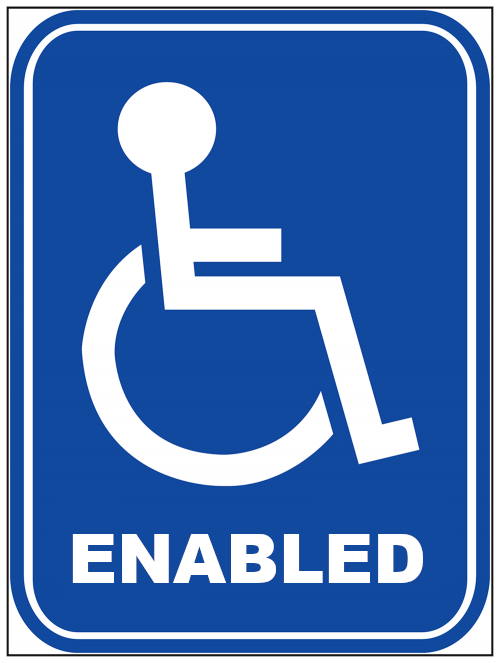
Being a writer I understand the power of words. Labels are words. The label ‘disabled’ was never intended to be a cause of harm. It is a descriptor, that is all. It is the use that society has put that word to in reference to people with disabilities that conjures all the negativity. It is time that this label was removed and replaced with something more positive and equally more human; ‘enabled’.
I am a person with disabilities, but I am enabled by medicines, orthotic footwear, and a walking stick. I am an enabled person and as such I am not going to refer to myself as disabled ever again.
 Peter C Whitaker
I hate putting labels on people. Each one of us is an individual in my eye. Although to my surprise some like to have a label, perhaps it makes them feel part of a group….it gives them an identity in a way. Society seems to like labels, it’s a way of fitting us all into neat little boxes, categories even, with no scope within the frame for individualism. I can totally empathise with your point when you feel the label is negative, and it’s frustrating that even though you no longer accept that label, society will still look at you and put you in that box. We need labels for all kinds of things…filing cabinets, spreadsheets, items that need to be categorised like books in a library, but people? Hmm….that really is a tough one! It seems a bit judgemental too …I don’t know, I’m rambling a bit, but I still don’t like labels for people. Outlook for Androidhttps://aka.ms/AAb9ysg ________________________________
LikeLiked by 1 person
I don’t mind labels, they help us understand the world we live in. Many people involved in categorising things try to ensure that the correct labels are used, however, and replace them when something more appropriate comes up. I think the term ‘disabled’ has acquired so many negative connotations that it needs replacing with a better descriptor. I know society will struggle with this idea but it has to begin somewhere so I am going to start with me and always refer to myself as enabled!
LikeLike